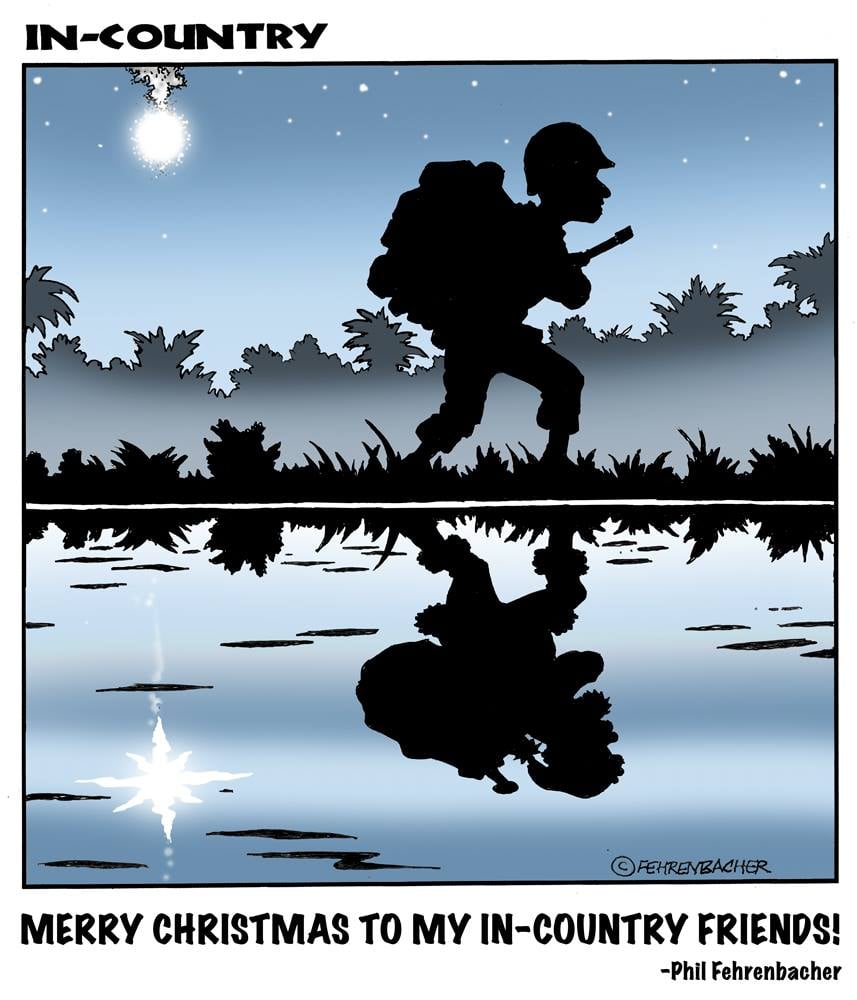
A satirical reflection by Author/Artist Phil Fehrenbacher
Phil enlisted in the Army in 1965 where he served for years in Vietnam. He became a graphic designer and has worked for the state of Oregon for 26 years. He retired in 2003 and started the Cartoon "In-Country". The cartoons reflect his experiences during his tour of duty in South Vietnam.
There is a new cartoon everyday.
Welcome to Post 4103!This Month in History
March 2, 1943 - During World War II in the Pacific, a Japanese convoy was attacked by 137 American bombers as the Battle of Bismarck Sea began. The convoy included eight destroyers and eight transports carrying 7,000 Japanese soldiers heading toward New Guinea. Four destroyers and all eight transports were sunk, resulting in 3,500 Japanese drowned, ending Japanese efforts to send reinforcements to New Guinea.
March 2, 1965 - Operation Rolling Thunder begins, initiating a sustained aerial bombardment campaign during the Vietnam War.
March 2, 1793 - Birthday - American soldier and politician Sam Houston (1793-1863) was born in Rockbridge County, Virginia. As a teenager he ran away and joined the Cherokee Indians who accepted him as a member of their tribe. He later served as a Congressman and Governor of Tennessee. In 1832, he became commander of the Texan army in the War for Texan Independence, defeating the larger Mexican army in 1836 at the Battle of San Jacinto. He then served as Senator and Governor of the new state of Texas but was removed in 1861 after refusing to swear allegiance to the Confederacy.
March 3, 1794: Congress passes the Naval Act of 1794, leading to the creation of the US Navy.
March 4, 1747 - Birthday - Revolutionary war hero Casimir Pulaski (1747-1779) was born in Poland. Before aiding in the American Revolution, he was a military leader in Poland's struggle against Imperial Russia. He joined the Americans in 1777 and fought alongside General Washington at Brandywine, then served at Germantown and Valley Forge. He was mortally wounded during a heroic charge in the Siege of Savannah, Georgia.
March 5, 1770 - The Boston Massacre occurred as a group of rowdy Americans harassed British soldiers who then opened fire, killing five and injuring six. The first man killed was Crispus Attucks, an African American. British Captain Thomas Preston and eight of his men were arrested and charged with murder. Their trial took place in October, with colonial lawyer John Adams defending the British. Captain Preston and six of his men were acquitted. Two others were found guilty of manslaughter, branded, then released.
March 6, 1836 - Fort Alamo fell to Mexican troops led by General Santa Anna. The Mexicans had begun the siege of the Texas fort on February 23rd, ending it with the killing of the last defender. "Remember the Alamo" became a rallying cry for Texans who went on to defeat Santa Anna in the Battle of San Jacinto in April.
March 7, 1945: U.S. forces secure the Ludendorff Bridge at Remagen during WWII.
March 8, 1863 - During the American Civil War, Confederate Colonel John Mosby, leader of Mosby's Rangers, captured Union General E.H. Stoughton at his headquarters in Fairfax County Courthouse, Virginia.
March 9, 1862 - The first battle between ironclad warships occurs at Hampton Roads, Virginia, between the Monitor and Virginia.
March 9, 1864 - Ulysses S. Grant was commissioned as a Lieutenant General and became commander of the Union armies.
March 11, 1941 - During World War II, the Lend-Lease program began allowing Britain to receive American weapons, machines, raw materials, training and repair services. Ships, planes, guns and shells, along with food, clothing and metals went to the embattled British while American warships began patrolling the North Atlantic and U.S troops were stationed in Greenland and Iceland. "We must be the great arsenal of democracy," President Roosevelt declared concerning the fight against Hitler's Germany. The initial appropriation was $7 Billion, but by 1946 the figure reached $50 Billion in aid from the U.S. to its Allies.
March 12, 1938 - Nazis invaded Austria, then absorbed the country into Hitler's Reich.
March 12, 1999 - Poland, Hungary and the Czech Republic became full-fledged members of NATO (North Atlantic Treaty Organization) less than ten years after exchanging communist rule for democracy and ending their Cold War military alliances with Soviet Russia.
March 15, 1767 - Birthday - Andrew Jackson (1767-1845) the 7th U.S. President was born in a log cabin in Waxhaw, South Carolina. As a boy he volunteered to serve in the American Revolution. Captured by the British, he refused an order to clean an officer's boots and was slashed by his sword. Jackson later gained fame as a hero during the War of 1812. In politics he helped form the new Democratic Party and became the first man from an impoverished background to be elected President, serving from 1829 to 1837.
March 16, 1802: Congress approves legislation establishing the United States Military Academy at West Point.
March 16, 1751 - Birthday - James Madison (1751-1836) the 4th U.S. President was born in Port Conway, Virginia. He played an important role in the formation of the new U.S. Constitution following the American Revolutionary War. During the War of 1812, President Madison was forced to flee Washington, D.C,. while the British attacked and burned the White House and other important public buildings.
March 17, 1776 - Early in the American Revolutionary War the British completed their evacuation of Boston following a successful siege conducted by Patriots. The event is still commemorated in Boston as Evacuation Day.
March 19, 1941: The 99th Pursuit Squadron (Tuskegee Airmen) is activated.
March 19, 2003 - The United States launched an attack against Iraq to topple dictator Saddam Hussein from power. The attack commenced with aerial strikes against military sites, followed the next day by an invasion of southern Iraq by U.S. and British ground troops. The troops made rapid progress northward and conquered the country's capital, Baghdad, just 21 days later, ending the rule of Saddam.
March 21, 1918 - During World War I, the Second Battle of the Somme began as German General Erich von Ludendorff launched an all-out drive to win the war. The battle began with a five-hour artillery barrage followed by a rush of German troops. The offensive lasted until April 6th and resulted in the Germans gaining about 35 miles of territory. Allied and German casualty figures for both battles approached 500,000.
March 21, 1943 - A suicide/assassination plot by German Army officers against Hitler failed as the conspirators were unable to locate a short fuse for the bomb which was to be carried in the coat pocket of General von Gersdorff to ceremonies Hitler was attending.
March 23, 1775 - Patrick Henry ignited the American Revolution with a speech before the Virginia convention in Richmond, stating, "I know not what course others may take; but as for me, give me liberty, or give me death!"
March 26, 1945: The Battle of Iwo Jima is won by American forces.
March 31, 1991 - The Soviet Republic of Georgia, birthplace of Josef Stalin, voted to declare its independence from Soviet Russia, after similar votes by Lithuania, Estonia and Latvia. Following the vote in Georgia, Russian troops were dispatched from Moscow under a state of emergency.
Iwo Jima: One Marine’s story
The Battle of Iwo Jima was one of the bloodiest battles of the Pacific Theater in World War II. It was the only battle in the Pacific where total American casualties exceeded those of the Japanese.
Every inch of the island was hard fought and the cost was enormous. American casualties numbered over 26,000, with several thousand killed.
On Feb. 23, 1945, under heavy enemy fire, Marines climbed Mount Suribachi to plant an American flag — a small flag initially, quickly replaced by a larger one intended to be seen across the island. The image, captured by a Marine and a war correspondent, would become a symbol of the persistence of American spirit.
PFC Jacklyn Lucas was one of the Marines who was there.
Lucas was only 14 years old when he forged his mother’s signature to become a Marine. Like many Americans, Pearl Harbor drove him to join.
"I would not settle for watching from the sidelines when the United States was in such desperate need of support from its citizens,” he said.
When he was discovered, he was relegated to truck driving duty. But that didn’t last long. He wanted to be in combat.
"I went AWOL to catch a train headed in the direction of the war. Then I stowed on a ship to reach one of the Pacific’s worst battlefields. I figured that if I was shrewd enough to impose my will on the United States Marine Corps, the [Japanese] would give me little trouble,” recalled Lucas.
While on board, he turned himself in and volunteered to fight so he wouldn’t be cited as a deserter. He was adopted into Company C, 1st Battalion, 26th Marines, 5th Marine Division as a rifleman.
Lucas turned 17 while onboard. The ship was headed to Iwo Jima.
Days after his 17th birthday, Lucas was moving through a ravine with three fellow Marines when their rifle team was ambushed. Lucas spotted two grenades near them when his rifle jammed. He leapt on the grenades, yelling to his comrades to take cover. While one of the grenades didn’t explode, Lucas absorbed the explosion of the other, saving the men fighting alongside him.
The Marines with him presumed he was dead and continued advancing. When they returned to collect his dog tags, they discovered he was still alive.
"By the time I was carried off of Iwo Jima I knew much more about esprit de corps and the sacrifices men are willing to make for each other than I could ever have imagined,” said Lucas.
The grenades left over 250 pieces of shrapnel in him. Even after 26 surgeries, he lived the rest of his life with much of it still lodged in his body.
Lucas would receive the Medal of Honor for his actions, becoming the youngest Marine and the youngest service member to earn the nation’s highest military decoration during World War II.
When asked whether he felt he was a hero for his actions on Iwo Jima, Lucas refuted the description.
"I don’t feel like I’m some big hero or anything like that. The real heroes are the ones who had to give their all.”
VFW Raises Serious Concerns Over VA Disability Rating Policy Interim Rule ChangeThe Department of Veterans Affairs (VA) published an interim final rule that immediately changes how disability ratings are evaluated, prompting the Veterans of Foreign Wars (VFW) to send a letter outlining its concerns to VA Secretary Doug Collins.For years, courts held that VA could not reduce ratings based on the effects of medication, requiring evaluation of a veteran’s true functional impairment when evaluating a service-connected disability. This new rule reverses that standard, directing examiners to rate disabilities as they present, including the impact of medication, and to disregard unmedicated baseline severity.Read more here.
...we want to welcome today's military service members into our ranks to become part of our elite group.
WWII, Korean War, Vietnam War, Persian Gulf War, Kosovo, War in Afghanistan, War in Iraq, War on Global Terror and other Peace-Keeping Expeditionary Campaigns throughout the globe.